MATCHA MIXOLOGY · BAKING GUIDE
Choose matcha for baking that fits your next recipe. Compare three matcha options, choose a sensible pack size and avoid buying a sweetened latte mix by mistake.
By Anton Babich · Product details checked November 11, 2026
The quick answer
For most matcha cookies, brownies and cakes, start with pure, unsweetened matcha that its manufacturer recommends for baking. A culinary powder is a practical option, but the word “culinary” is not a complete quality comparison. Check the exact blend, ingredients, package weight and recipe quantity before buying.
Affiliate disclosure: As an Amazon Associate I earn from qualifying purchases. Amazon links below are affiliate links. They open product searches; check the exact blend, size, seller and current price. Ippodo and manufacturer reference links are not affiliate links.
This is a research-based buying guide, not a hands-on taste test. Product descriptions and intended uses come from the manufacturers. We have not baked side-by-side test batches with these three powders. Read our editorial standards.
Compare powders ·Choose your matcha ·Pack size & cost ·Pick a recipe ·Questions
Matcha powder for baking: a quick comparison
“Best” depends on what you are making and how often you bake. These are three specific options whose makers describe a baking use.
| Powder | Why consider it? | Check before buying |
|---|---|---|
| Jade Leaf Organic Culinary Matcha | A baking-focused option with several pack sizes. | Choose pure Culinary Matcha, not the brand’s latte mix. |
| Naoki Organic All Purpose Culinary Matcha | A second-harvest blend the maker recommends for bakes and blended recipes. | The maker describes some bitterness; this is different from Superior Blend. |
| Ippodo Wakaki · 20 g | A smaller pack specifically recommended for baking by Ippodo’s US site. | Check recipe quantity first: 20 g may not cover your whole batch. |
On a small screen, swipe the comparison table sideways if needed.
Jade Leaf Organic Culinary Matcha
Consider it for: choosing a pack around your baking routine.
Jade Leaf markets this pure organic Japanese matcha for baked goods and blended recipes. Its listed formats include 30 g, 100 g, 250 g and a 1 lb pouch. That range lets you compare a small first purchase with a larger supply once you know you like it.
Choose the quantity you can use while following the maker’s storage directions. A larger bag is only useful value if you will finish it; do not choose by package price alone.
Naoki Organic All Purpose Culinary Matcha
Consider it for: a powder made for mixed recipes.
Naoki describes this as a Japanese second-harvest culinary blend for baking, smoothies and protein shakes. The maker characterizes its flavor as robust with moderate bitterness. That is a manufacturer description, not a tasting result from our kitchen.
The product page lists 1.4 oz and 3.5 oz formats. Confirm the selected weight at checkout. Choose this exact All Purpose Culinary product if you want the option discussed here; Naoki’s Superior Blend is a separate tea.
Ippodo Wakaki · 20 g box
Consider it for: a small pack with a specific baking recommendation.
Ippodo’s US baking FAQ recommends Wakaki. Its product page describes a light blend with noticeable astringency, and lists a 20 g box. It is also intended for drinking, so a baking recommendation does not mean a powder is unsuitable for tea.
Work backward from your recipe before choosing this smaller format. If a recipe needs more than the pack contains, compare the cost of multiple boxes with a larger culinary pack. Stock can change; check the current listing.
Direct manufacturer link; not an affiliate link. See Ippodo’s baking recommendation.
How to choose the best matcha for your bake
1. Start with the ingredient list
When a recipe calls for pure matcha, choose a product whose ingredient is matcha tea powder. A sweetened latte blend can also contain sugar, milk powder or other ingredients. A spoonful of that blend does not supply the same amount of tea as a spoonful of pure powder.
2. Match the powder to the recipe
Use a maker’s baking recommendation as your starting point. For a delicate frosting or a dessert in which the tea is prominent, consider whether the maker’s flavor description fits the result you want. For a full batch, follow an established recipe rather than adding an arbitrary scoop to an unrelated cake formula.
3. Treat grade labels as a starting point
You do not need to buy a product labeled ceremonial just to bake. Ippodo does not use that marketing term for its teas, and still names a specific blend for baking. Comparing ingredients, intended use and cost is more useful than assuming the most expensive label is the best choice for every dessert.
4. Keep the first comparison simple
If you try a second powder, keep the recipe, ingredient quantities and pan the same. Note the exact blend and how much you used. Your preferred result is more useful than comparing a cookie made with one powder to a completely different cake made with another.
Buy enough for your recipe—not just the cheapest bag
Cost of matcha in a batch = current pack price ÷ pack weight in grams × grams used.
For example, if your chosen recipe uses 10 g, a 30 g pack covers three batches and a 100 g pack covers ten, before handling losses. This is a pack-size example, not a recommended dose for every recipe.
Include delivery costs when comparing offers. If your recipe uses tablespoons, keep its published measure or use a verified weight conversion; do not assume every spoonful weighs the same.
Simple tools for smoother preparation
Start with the sieve, bowls and measuring tools you already own. You do not need a ceremonial whisk set just to make cookie dough.
- A fine-mesh sieve: useful for breaking up dry powder clumps before mixing. Choose a size that suits the amount of powder and your bowl. Our matcha sifter guide compares tools and explains how to break up clumps. Browse fine-mesh baking sieves on Amazon.
- A suitable kitchen scale: useful when the recipe supplies weights. Check the scale’s smallest increment and minimum weighing amount for small powder portions. Browse small-increment kitchen scales on Amazon.
- The correct pan: use the size specified in your recipe; a different pan changes the batter depth. Our matcha kitchen tools guide covers other useful equipment.
Put your matcha powder to work
SOFT CENTERS
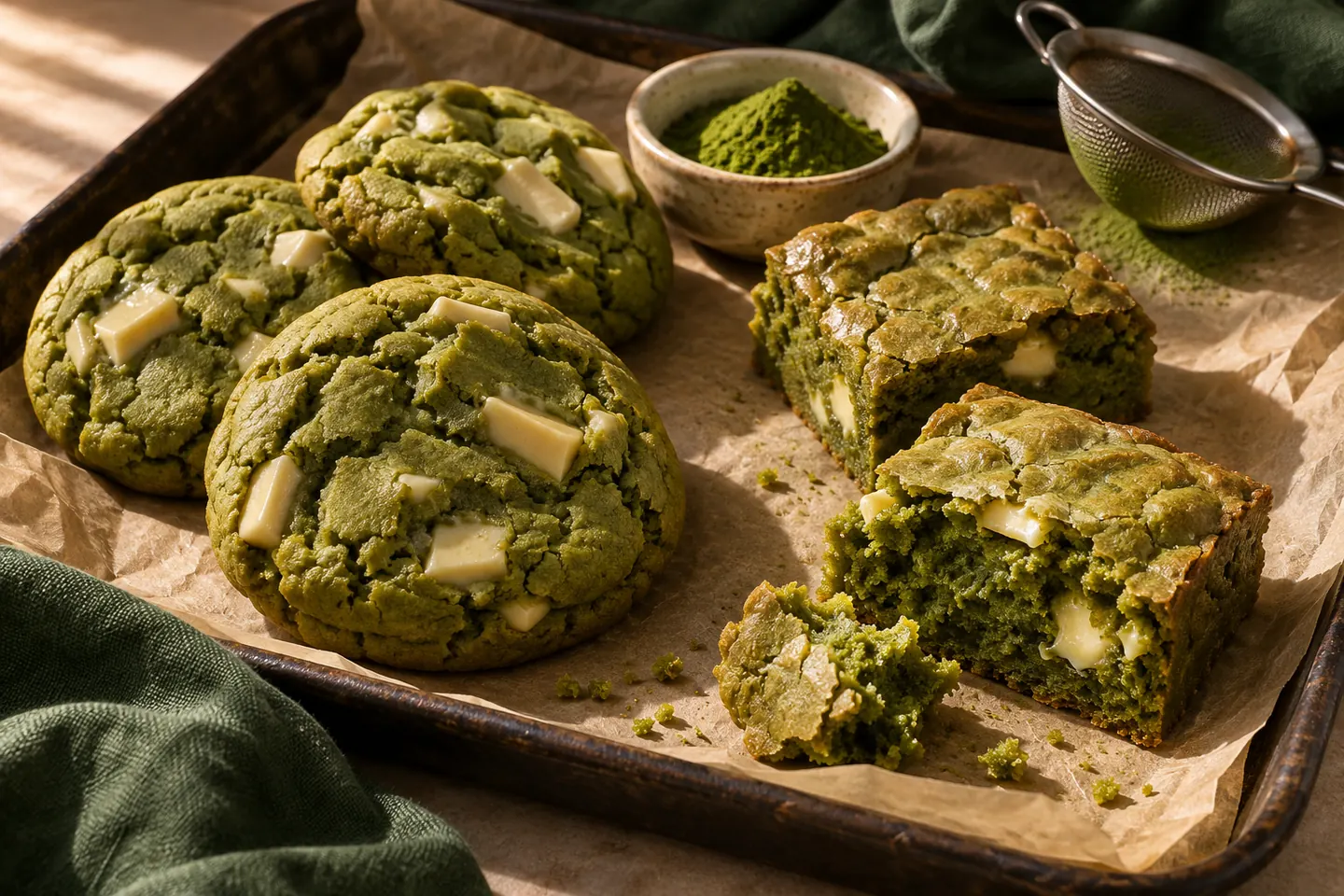
Matcha white chocolate cookies
Choose this recipe for individual cookies with white chocolate. Follow its ingredient quantities and chilling instructions.
ONE SQUARE PAN
Matcha brownies
Our green, white-chocolate batch uses an 8-inch square pan. Check its matcha quantity before deciding how much powder to buy.
A SNOWY SUGAR CRUST
Matcha crinkle cookies
A different cookie finish for the same baking collection. Use the complete crinkle recipe rather than changing the white-chocolate dough.
For cakes and other dessert directions, explore our matcha dessert collection. Choosing powder mainly for drinks? Use the separate matcha powder for lattes guide.
Matcha for baking: common questions
Can I use ceremonial matcha for baking?
You can use pure matcha that fits the recipe, including a powder marketed as ceremonial. The useful question is whether its flavor, intended use and cost suit your bake. A baking-focused powder can be a more practical purchase than an expensive tea chosen mainly for drinking.
Can I substitute a sweetened matcha latte mix?
Do not swap it one-for-one into a recipe written for pure matcha. Its added ingredients change the tea concentration and the rest of the formula. Choose a recipe developed for that exact mix instead.
How much matcha should I add to cake or cookies?
Follow a complete recipe first. Jade Leaf suggests 1–3 teaspoons per cup of flour for adapting baked recipes, but that is the brand’s starting guidance, not a universal formula. A small trial is sensible when adapting a recipe; keep notes before scaling up.
Does baking matcha work in a latte?
Check the specific maker’s guidance. Some baking options are also intended for drinks, while others are positioned around blended recipes. Decide whether you like the result in your usual milk before buying a larger package.
How should I store the powder?
Follow the package directions and date information, close the pack promptly after measuring and keep moisture out. Our matcha storage guide explains the practical considerations.
Sources & how this guide was selected
We selected these options because their manufacturers explicitly identify baking as a use. The comparison considers ingredients, pack formats, maker-described flavor and buying checks. We do not assign taste scores or claim one powder won a kitchen test.